JSM celebrates Highly Commended Gold Award win in the City of London

JSM Group is celebrating another major achievement after receiving a Highly Commended Gold Award at the City of London Corporation’s Considerate Contractor Streetworks Scheme Awards. The award recognises contractors that consistently exceed the standards set out in the Code of Good Practice, reflecting excellence in areas such as planning, coordination, accountability, innovation and commitment to high standards across streetworks activity in the Square Mile.

Presented at the awards ceremony on Friday 8 May, the recognition marks more than 20 years of JSM’s involvement in the scheme and highlights the consistently strong performance of the business in one of the UK’s most complex and demanding operating environments. It is a testament to the expertise, professionalism and dedication of JSM’s Digital Infrastructure team, whose work in the City continues to demonstrate a strong focus on safety, quality, programme delivery and close collaboration with stakeholders and authorities.

Joe Scanlon, Associate Director – Civils, said:

We were honoured to represent JSM Group at the City of London Awards and accept a Highly Commended Gold Award – a recognition we have developed for over 20 years. This achievement is a direct reflection of the outstanding performance of our Digital Infrastructure team in the Square Mile, whose unwavering focus on safety, quality, programme delivery and collaboration with stakeholders and authorities continues to drive excellence across our operations.

This latest success reinforces JSM’s long-standing reputation for delivering high-quality infrastructure services responsibly and considerately, while helping keep the City connected and moving. It also reflects the strength of the teams behind the work, from planning and permits through to delivery on site, whose commitment continues to set the standard year after year.

We are pleased to announce that the first cohort of Front-Line Supervisors has successfully completed Level 1 of the JSM Leadership Academy – “Leading the Frontline.” This marks a significant milestone in our commitment to developing strong, capable leaders across our organisation. 

As a result of completing this programme, participants have achieved the CITB Supervisor CSCS Gold Card, following their completion of the NOCN Level 3 Occupational Work Supervision NVQ. This accreditation reflects the high standards of competence, professionalism, and leadership that the programme is designed to build. 

This inaugural group has demonstrated exceptional dedication and resilience, balancing demanding site responsibilities with a rigorous development programme. Their commitment to strengthening health and safety, operational excellence, and continuous improvement sets a strong benchmark for future cohorts. 

We also extend our appreciation to HSP Training for their ongoing partnership and to Aaron Hickman, NVQ Assessor, for his support throughout the assessment process. He shared: 

These delegates showed outstanding dedication and a real commitment to health, safety, and leadership on site. JSM were incredibly supportive throughout the assessment process, ensuring their team had everything they needed to succeed. A hugely well‑deserved achievement for everyone involved! 

Our Chief People Officer, Helen Stewart, added: 
Huge congratulations to our first cohort completing the Leading the Frontline course from our Leadership Academy. Taking time away from your day job is never easy, especially for our supervisory teams in busy roles and projects. Your commitment to your role and company is demonstrated in the outcome of this training. Thank you! This programme exists to build the leaders JSM needs, and this is just the start.

We are incredibly proud of this achievement and look forward to seeing these newly qualified Supervisors continue to grow, inspire, and lead within JSM. 

Here’s to building safer sites, stronger teams, and brighter futures. 

Last week, members of the JSM team spent the day volunteering at the Barking Foodbank, supporting the charity’s vital work within the local community.

The team kicked off the day with a food run at ASDA, using a £400 budget to purchase essential supplies requested by the Foodbank. They then spent the remainder of the day categorising, dating and organising stock in the warehouse to help streamline operations ahead of a busy period.

The Foodbank’s Operations Manager, Funmi Ikele, shared her appreciation for the ongoing support:

JSM has supported our food bank faithfully for the past 3 years, volunteering at our warehouse. We appreciate every time they come because the help get so much work done. This time around, they came with a budget of £400 helping us to get much needed food items. We are so glad to see so many regular faces and we look forward to a continued partnership.

Alongside this volunteer effort, JSM will be collecting food donations throughout the month of April at both of our main sites in Potters Bar and River Road. All of which will be passed directly to the Barking Foodbank to support individuals and families experiencing food insecurity. This forms a key part of JSM’s annual commitment to giving back and supporting the communities where we work.

Reflecting on the ongoing initiative, JSM’s Environmental Manager, Claire Parsons, who organises the event each year, shared the following:

As Funmi shared, JSM has supported the Foodbank for the past three years, and the need for food assistance has grown sharply in that time. Our volunteers were struck by how low stock levels were this year, which prompted us to take further action. We’re launching a donation initiative to help replenish essential items, with a dedicated QR code and cash donation points at Potters Bar and River Road. JSM will match the total raised, enabling us to purchase priority supplies and deliver them to local collection points. We remain committed to supporting our communities and helping ensure vital services like the Barking Foodbank can continue their important work.

The day was a great success and further strengthens JSM’s long-standing relationship with the Barking Foodbank, reaffirming our dedication to supporting meaningful causes and making a positive impact within the communities we serve.

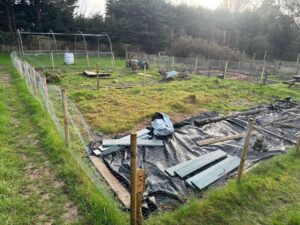
At JSM, we’re proud to empower our people to support the causes they care about through our Community Grant scheme. One recent project comes from Oliver Wales, Project Manager at JSM, who applied successfully for funding on behalf of his local allotment community, an initiative focused on improving shared spaces, protecting crops, and creating long‑term sustainability for all plot holders. 

Thanks to the grant, the allotment was able to rent an excavator for a weekend in December to dig the trenches required for a brand-new shared chicken coop. Since then, volunteers have been hard at work, and the boundary fencing was fully installed just last weekend. Once complete, the coop will be shared between allotment holders, with a rotational care system and plans for up to 12 chickens, providing participating members with fresh eggs daily. Final touches, including securing the perimeter with chicken wire, will take place over the coming months, with hopes of welcoming the chickens later this summer. 

The larger portion of the funding went toward purchasing as many fence posts and as much chicken wire as possible to protect three vulnerable plots that were facing ongoing damage from rabbits. Through savvy negotiating with local suppliers, the team managed to stretch the budget far beyond expectations, enough to fence six plots in total, doubling the original plan. This included repairing an older plot in need of attention and fencing two additional plots whose owners didn’t expect to be included. They were thrilled with the outcome. 

Committee Chairman, Peter Smith, shared this message of thanks: 

Last week, we were delighted to support Latton Green Primary Academy in Harlow following their call to help to enhance outdoor creative play. The school reached out requesting items such as cones, barriers, signs and other resources the children could use to spark imagination during outdoor learning. We were pleased to donate a Road Safety Kit to help them create a fun, engaging and educational play environment.

The school shared their appreciation, saying:

The road safety kit has already made a fantastic impact on the children’s play and learning. They’ve loved using the signs, cones and barriers to create ‘road works’, redesign scooter routes, and work together, supporting teamwork, communication and early road safety awareness. We’re incredibly grateful for your generosity.

Community support is an important part of what we do at JSM, and we’re proud to play a small part in helping local schools enrich their pupils’ learning experiences.

This Bytesized piece explores Horizontal Directional Drilling (HDD) in action – a quick, practical insight into one of the most effective low‑impact installation methods in the industry.

What is Horizontal Directional Drilling (HDD) and why is it used?

HDD is widely used by civil engineering contractors to install underground utilities without disturbing the surface, making it ideal for congested or sensitive environments. By drilling a guided underground path and pulling pipes or cables through in one continuous section, HDD minimises disruption, reduces environmental impact, and keeps infrastructure running as normal.

How was HDD applied on this high-constraint project?

A recent JSM project demonstrates this in action. The team was tasked with installing a high‑voltage cable route beneath a corridor packed with constraints, including dense utilities, environmentally sensitive features, operational areas, and live traffic movements. Traditional excavation wasn’t feasible.

How did engineering expertise ensure safe delivery?

Using gyro‑guided steering, staged drilling, real‑time monitoring, and strict environmental controls, the team delivered a minimal‑surface‑impact installation, completed in under five days. All surrounding operations, access routes, and habitats remained fully protected throughout. The project reflects best practice in civil engineering delivery within complex utility environments.

Why is HDD a preferred method for modern infrastructure projects?

This case study highlights why HDD has become a preferred method for modern infrastructure delivery: precision, safety, speed, and minimal disruption, even in the most challenging environments. 

JSM Academy has officially launched its new Transformational Leadership Programme, with around 10 senior leaders from across the business attending Day one of the programme. The programme is being delivered in partnership with John Bullock of Solution Focused, our trusted training partner, and marks an important step in JSM’s continued investment in leadership capability and organisational growth. This group of leaders will embark on a structured development journey designed to strengthen their ability to lead from the front, inspire high-performing teams, and drive sustainable change across the business. The programme focuses on modern, practical leadership approaches that reflect the evolving demands of today’s workplace. Throughout the programme, leaders will explore a range of key subject areas, including:
  • Team Leadership – building trust, accountability, and collaboration.
  • Influencing & Communication Skills – leading with clarity, confidence, and impact.
  • Visionary Leadership – setting direction and inspiring others to deliver the future vision.
  • Corporate & Leadership Responsibility – leading ethically and responsibly.
  • Personal Development Planning – embedding learning into day-to-day leadership practice.
Day one set the foundation for the months ahead, encouraging open discussion, reflection, and a shared commitment to personal and professional growth. Participants were challenged to think differently about leadership, their impact on others, and how they can role-model JSM values in everything they do.
The Transformational Leadership Programme has been a real eyeopener. It’s pushed me to reflect on how I lead, communicate, and support my teamnot just in the big moments, but in the everyday interactions that shape our culture. I’m already applying the tools we learned on Day one, and I can see the difference they’re making. – Riaz Cadersaib, Head of Pre-Construction.
This programme represents a significant milestone for JSM Academy and reinforces our commitment to developing strong, capable leaders who can support both people and performance as the business continues to grow.
With over 37 years of experience in the electrical industry, Darren Cooper oversees all commercial operations within the pre-construction business, including managing a team of electrical estimators. He ensures tender bids are accurately prepared and submitted on time, and is responsible for delivering high standards of customer service and operational efficiency, making sure the division meets its commercial objectives while upholding professionalism and client satisfaction. The role of the estimator in utility infrastructure installation – especially in sectors like energy and telecommunications – has evolved dramatically over the past decade. Once confined to calculating costs and compiling spreadsheets, today’s estimators are strategic contributors to project planning, risk mitigation, and technological integration. This transformation reflects broader shifts in the industry, driven by digital innovation, regulatory complexity, and sustainability goals.  From cost calculator to strategic planner  Traditionally, estimators focused on quantifying materials, labour, and equipment to produce accurate bids. Their work was largely reactive, based on historical data and standardised pricing models. However, as utility projects have grown more complex – with tighter timelines, diverse stakeholders, and evolving technologies – the estimator’s role has expanded.  Modern estimators are now embedded in the early stages of project development. They collaborate with engineers, project managers, and procurement teams to shape scope, assess feasibility, and forecast risks. Their insights influence design decisions, budgeting strategies, and even regulatory compliance. In essence, the estimator has become a linchpin in ensuring utility projects are delivered on time, within budget, and aligned with strategic goals.  Skills for the modern estimator  To thrive in this new landscape, estimators must possess a broader and more sophisticated skill set: 
  • Digital fluency: Proficiency in cost estimation software (e.g. ConQuest, Causeway), BIM tools, and cloud-based collaboration platforms is essential.
  • Data analysis: Estimators must interpret historical data, market trends, and predictive models to refine estimates and anticipate cost fluctuations.
  • Regulatory knowledge: Understanding environmental regulations, safety standards, technical standards and permitting requirements helps estimators account for compliance costs and avoid delays.
  • Communication and collaboration: Estimators must work closely with cross-functional teams, presenting findings clearly and negotiating scope changes effectively.
  • Risk management: Identifying uncertainties – such as supply chain disruptions or labour shortages – and building contingencies into estimates is now a core responsibility.
[column_divider] The rise of Extra High Voltage (EHV) expertise  One of the most significant recent developments in utility infrastructure is the surge in demand for extra high voltage (EHV) installations. This is largely driven by two forces: the proliferation of data centres and the rapid expansion of renewable energy sources. 
  • Data centres, with their massive energy requirements and need for uninterrupted power, often require direct connections at EHV on to distribution and transmission networks operating at 132kV and above. Estimators must understand the unique challenges of EHV installations, including specialised equipment, installation standards, and spatial constraints.
  • Renewable energy projects, such as large-scale solar farms and offshore wind installations, increasingly feed into the grid at EHV distribution and transmission-level voltages. Estimators must be able to assess the cost and complexity of connecting these sources to existing infrastructure, often across remote or difficult terrain.
As a result, estimators now need to be fluent in EHV design principles, substation configurations, and transmission line construction. They must also factor in advanced protection systems, grid compliance requirements, and long-term maintenance considerations. This expertise ensures accurate budgeting and risk assessment for projects that are critical to national energy strategies.  Influences shaping the role  Several key influences are driving this evolution: 
  • Technological advancement: The rise of smart grids, renewable energy systems, and digital twins has introduced new variables into utility projects. Estimators must understand these technologies to assess their impact on cost and schedule. 
  • Sustainability and ESG: Projects are increasingly evaluated through environmental, social, and governance (ESG) lenses. Estimators must factor in carbon footprints, energy efficiency, and long-term operational costs. 
  • Economic volatility: Fluctuating material prices, inflation, and global supply chain issues require estimators to be agile and informed. 
  • Workforce dynamics: Skilled labour shortages and changing workforce expectations influence labour cost assumptions and scheduling. 
These factors demand that estimators remain adaptable, informed, and proactive.  View out latest Estimator vacancies.
At JSM Group, a leading Utility Infrastructure Provider delivering integrated utility infrastructure solutions, our commitment to precision and innovation continues to shape the way we approach infrastructure planning and engineering services. One area where this is especially evident is in our use of bathymetric surveys, a technique that has evolved dramatically over time, transforming from rudimentary depth measurements to high-resolution underwater mapping. Nick Stillwell, a Pre-Construction Supervisor at JSM, explains how bathymetric surveys now play a critical role in supporting our utility infrastructure solutions and other engineering projects during the early planning stages. How have bathymetric surveys evolved to support modern infrastructure planning? Bathymetric surveying has a surprisingly ancient origin, dating back over 3,000 years to Ancient Egypt, where they relied on manual methods like lead lines and sounding poles, offering limited accuracy and coverage. Today, technologies such as Single Beam Sonar, GNSS, and Total Station workflows allow us to capture detailed spatial data with speed and precision. This evolution has unlocked new possibilities for infrastructure development, environmental monitoring, and flood risk management.  Why is bathymetric surveying critical for integrated land and water design? In a recent project, our team conducted a comprehensive bathymetric and topographic survey over two days, with a one-day turnaround on reporting. With the goal to support infrastructure planning with reliable, high-resolution data and by integrating underwater and land-based surveying techniques, we created a seamless model of the land-water interface which is critical for accurate volume calculations and design planning.  The resulting data provided planners, engineers, and stakeholders with the confidence to progress designs efficiently and reduce risk at later project stages.
JSM employee using Total Station during a Bathymetric survey
What challenges do bathymetric surveys present on complex infrastructure projects? Bathymetric surveying presents unique technical and environmental challenges. Factors such as water movement, visibility constraints, and restricted access require careful coordination, specialist training, and robust workflows. However, through and robust workflows, JSM successfully delivered:
  • Full 3D surface models
  • Detailed CAD drawings
  • GIS-ready datasets suitable for integration into wider utility infrastructure solutions and digital infrastructure contractor workflows
These outputs empower engineers and planners working across utility services and other engineering frameworks to move forward with clarity and confidence. How are bathymetric surveys shaping the future of resilient infrastructure? As infrastructure projects become more complex and climate resilience more urgent, bathymetric surveys are no longer niche, they are essential. They enable a deeper understanding of submerged environments, support risk assessment, and allow infrastructure to be designed with long-term resilience in mind. At JSM, we’re proud to be at the forefront of this evolution, using cutting-edge survey technologies to support utility infrastructure experts, integrated utility infrastructure solutions, and full turnkey services across the UK and beyond. By combining innovation with engineering expertise, we continue to deliver insights that help shape the future of sustainable, resilient infrastructure.  

At JSM, we believe that small acts of support can lead to big community impact. That’s why our Community Grant scheme exists, to help our employees champion causes close to their hearts. 

One recent example comes from Kyle Bassett, a SHEQ advisor here at JSM, who applied for a grant to support his local girls’ football team, the Lliswerry Lizards’ Dragonesses. His successful application enabled the team to receive brand-new coats, helping them stay warm and united as they represent their club with pride. 

The coats were more than just practical; they were a symbol of encouragement and recognition for the team’s dedication and spirit. We were thrilled to receive a message of thanks from Kyle, the team coach: 

“The girls are absolutely delighted with their new coats and truly grateful for JSM’s generosity.”

This initiative reflects the heart of our grant scheme: empowering our people to make a difference where it matters most. Whether it’s supporting youth sports, local events, or community organisations, we’re proud to stand behind our employees and the causes they care about. 

We look forward to seeing the Dragonesses thrive and we’ll be cheering them on every step of the way.